Showing posts with label housing market. Show all posts

Tuesday, July 28, 2015

Bay Area Inventory Shortages Fuel June Home Price Gains
July 23, 2015 by Pacific Union • Posted in Home Sales Volume & Inventory Conditions

Home inventory dropped in all nine Bay Area counties last month, driving prices higher from one year ago and ensuring that multiple offers remain commonplace.

In its June 2015 sales and price report, the California Association of Realtors says that the months’ supply of inventory (MSI) for single-family homes declined to 2.0 across the nine-county Bay Area in June, down from 2.2 in May and 2.5 from one year ago. San Mateo County had the most severe supply constraint in state, with an MSI of 1.5, followed by Santa Clara and San Francisco counties (1.7), Alameda County (1.8), and Contra Costa County (2.0). CAR says that an MSI of 6.0 to 7.0 is typically considered to be a balanced market, with larger numbers favoring buyers and smaller numbers favoring sellers.

The median sales price in the Bay Area was $833,330, down 1.6 percent from May but up 7.7 percent from a year ago, outpacing the state’s annual home price growth of 7.0 percent. In a statement accompanying the report, CAR President Chris Kutzkey attributed the Bay Area’s home price gains to supply limitations.

“Home prices continue to improve but at a more moderate rate compared with the previous year,” she said. “However, in areas such as the San Francisco Bay Area where tight inventory is fueling stiff competition and generating multiple offers, home prices are still rising at or near double-digit rates, and creating a challenging environment for potential buyers in the region.”

On an annual basis, prices were up in all nine counties, ranging from 15.4 percent in Napa and Sonoma counties to 9.5 percent in Alameda County. The Bay Area is home to the six most expensive counties in California, led by San Francisco, where the median sales price was $1,339,290 in June. San Mateo County was just a step behind, with a median sales price of $1,300,000, followed by Marin ($1,163,460), Santa Clara ($990,000), Contra Costa ($839,910), and Alameda ($814,480) counties.

Slim inventory levels and heated competition for available homes mean that Bay Area homebuyers continue to pay more than list price, even as buyers across the state enjoyed slight discounts. CAR says that Bay Area homes are selling for an average of 106.3 percent of original list prices compared with 99 percent statewide.

While June Bay Area home sales increased by 9.4 from May and 11.1 percent from a year ago, the number of active listings declined a substantial 10.7 percent on an annual basis, adding another complication to a housing market that’s already difficult for many buyers.

(Photo: Flickr/woodleywonderworks)

Thursday, June 11, 2015

California Dominates List of Most Thriving U.S. Housing Markets

June 4, 2015 by Pacific Union • Posted in Market Conditions
Demand for Golden State real estate remained strong in May, with California metro areas accounting for half of what Realtor.com deems the country’s hottest markets.

Using a combination of the number of views per listing on its website and the median age of inventory, Realtor.com compiled a list of the 20 hottest U.S. real estate markets for buyers and sellers. Housing supply shortages and a booming economy landed 10 California metro areas on the list, seven of them located in the northern part of the state.

Realtor.com ranks the San Francisco-Oakland-Hayward metro area as the nation’s second hottest housing market, followed by the San Jose-Sunnyvale-Santa Clara area at No. 3. Both regions held the same spot on Realtor.com’s list of hottest markets in April.

The Vallejo-Fairfield metro area ranked No. 5, also unchanged from the previous month. Santa Cruz-Watsonville placed No. 7, swapping places with Santa Rosa, which dropped one spot from April to the No. 8 position. After not ranking among the nation’s 20 hottest markets in April, Sacramento moved up to No. 12, while Stockton came in at No. 20. In Southern California, the San Diego, Oxnard-Thousand Oaks-Ventura, and Los Angeles-Long Beach-Anaheim metro areas also counted among the top 20.

According to Realtor.com Chief Economist Jonathan Smoke, it’s not unusual to see demand for homes in the Sacramento region spike after strong growth in the Bay Area housing market, thanks to its relative affordability. However, during this cycle, Sacramento is experiencing above-average employment gains, leading to an uptick in the number of household formations.

Realtor.com doesn’t provide median days on market times for individual regions, noting only that homes across the country stayed on the market 66 days in May. But a look at the most recent sales data from the California Association of Realtors shows that the Golden State’s housing market is moving at about twice the speed of the U.S. market, with single-family homes selling in a median 34.2 days in April.

Bay Area homes are selling even faster, with properties on the market a median of 29.8 days across the nine-county region in April. Homes in San Mateo and Santa Clara counties sold at the quickest clip of any in California, 17.4 and 17.5 days, respectively. San Francisco tied Kern County in the Central Valley for third-fastest sales pace in the state: 21.0 days.


(Photo: Flickr/Druh Scoff)

Thursday, May 14, 2015

San Francisco One of World’s Hottest Luxury Real Estate Markets in 2014

May 6, 2015 by Pacific Union • Posted in Market Conditions

A home in San Francisco’s Presidio Heights neighborhood.

After astounding growth in 2013, luxury property sales returned to more normal levels in San Francisco last year, although the region still ranks as one of the top-performing high-end real estate markets in the world.

In its 2015 Luxury Defined report, Christie’s International Real Estate gave San Francisco the second-highest score – 54 of a possible 100 – on its Luxury Thermometer metric, which tracks growth and demand at the top end of the global market. CIRE uses four factors to gauge a region’s luxury temperature, including annual sales growth and fewest average days on market.

In 2014, sales of $1 million homes in San Francsico grew by 19 percent on an annual basis, down from a whopping 62 percent in 2013. Pacific Union CEO Mark A. McLaughlin told CIRE that the slowdown was predictable and that the region’s high-performance economy will continue to drive growth in luxury home sales.

“The Bay Area is still experiencing a perfect storm of hot market conditions, exceptional job growth, excellent income levels, and limited supply,” McLaughlin said.

Because housing inventory in the Bay Area remains constrained, high-end homes in San Francisco leave the market quickly. According to the report, luxury homes in our region sold in an average of 71 days as of December 2014, eight days faster than a year ago and second only to Toronto.

And though San Francisco remains a pricey place to purchase a luxury property, it is still relatively affordable by global – and even national – standards. CIRE says the entry point for a luxury home in San Francisco is $3 million, compared with $5 million in New York, $6 million in London, and $8 million in Los Angeles.

Luxury buyers can also get more home for their money in the Bay Area than they can in other top international destinations, says the report, which compares listings from around the globe. For $5 million, a homebuyer in San Francisco could purchase a four-bedroom, 4,800-square-foot, single-family home with Golden Gate Bridge views. In London, $5 million buys a two-bedroom, 1,300-square-foot flat, while in New York, that money fetches a three-bedroom, 1,865-square-foot condominium on Manhattan’s Upper East Side.

Last year saw an uptick of so-called “trophy home” transactions, CIRE says, with global sales of $100-million-plus homes reaching an all-time high. According to the report, five such homes around the world sold in 2014, and there have been 13 $100-million-plus sales since 2010.

Perhaps unsurprisingly, two of those 13 trophy sales happened in Silicon Valley, where mind-bogglingly expensive real estate is almost a given. In 2011, a single-family home in Los Altos Hills found a buyer for $100 million, while a home in Woodside sold for $117.5 million the following year.

(Photo: Flickr/Allan Ferguson)

Articles and photos sourced from: www.pacificunion.com 

Monday, September 29, 2014

Gallup Poll: Real Estate “Heading in the Right Direction”


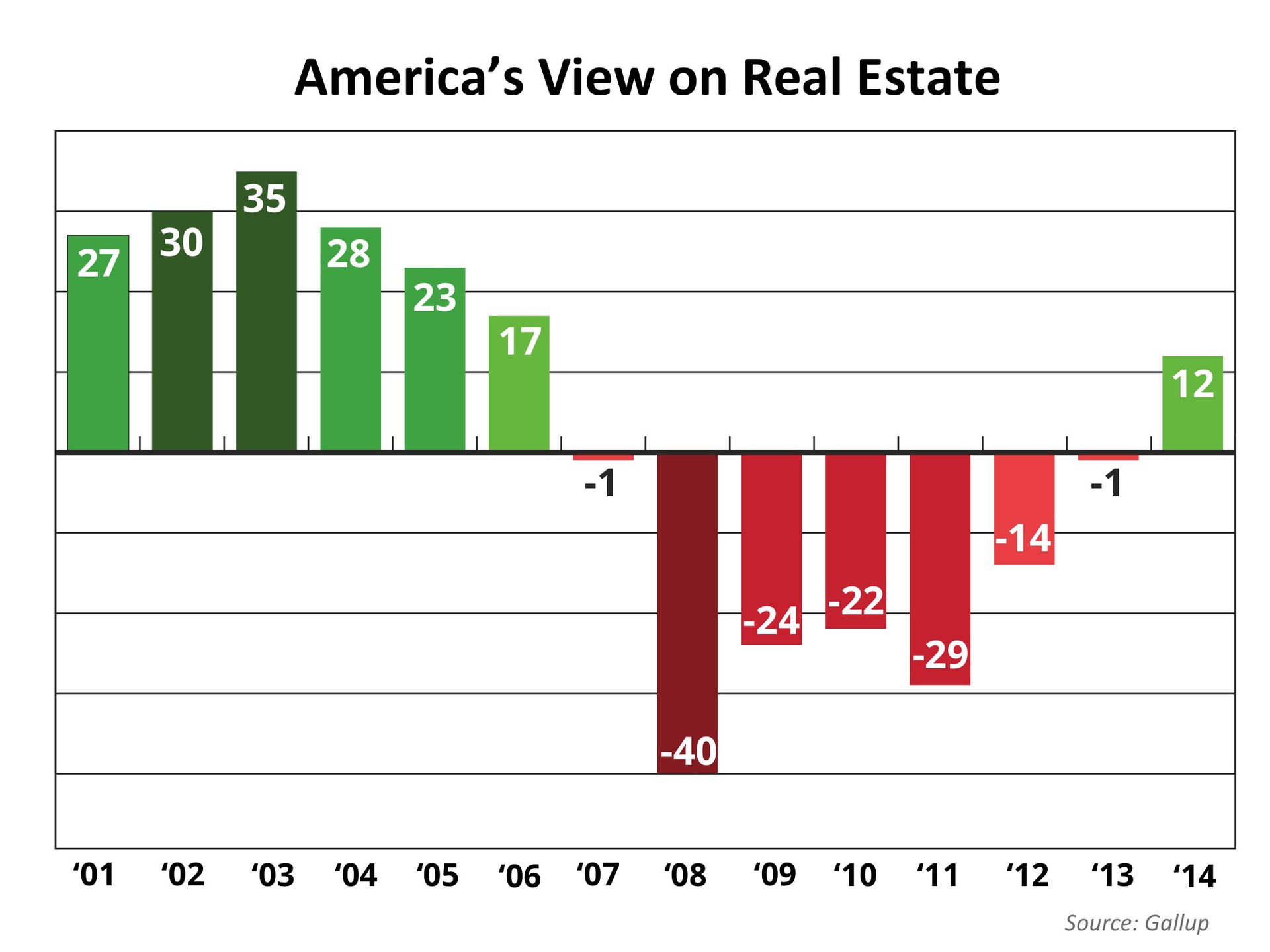
In a recent Gallup poll, Americans were asked to rate 24 different business sectors and industries on a five-point scale ranging from "very positive" to "very negative." The poll was first conducted in 2001, and has been used as an indicator of “Americans’ overall attitudes toward each industry”.
For the first time since 2006, Americans had an overall positive view of real estate, giving the industry a 12% positive ranking.
Real Estate “Heading in the Right Direction” | Keeping Current Matters

Americans’ view of the real estate industry worsened from 2003 to the -40% plummet of 2008.  Gallup offers some insight into the reason for decline:

Prices Dropped

“In late 2006, real estate prices in the U.S. began falling rapidly, and continued to drop. Many homeowners saw their home values plummet, likely contributing to real estate's image taking a hard hit.”

Housing Bubble

“The large drops in the positive images of banking and real estate in 2008 and 2009 reflect both industries' close ties to the recession, which was precipitated in large part because of the mortgage-related housing bubble.”

Bottom Line

“Although the image of real estate remains below the average of 24 industries Gallup has tracked, the sharp recovery from previous extreme low points suggests it is heading in the right direction.”

Article and Photos Sourced From:  http://www.keepingcurrentmatters.com/2014/09/25/gallup-poll-real-estate-heading-in-the-right-direction/?utm_source=feedburner&utm_medium=email&utm_campaign=Blog_Promo

Wednesday, July 2, 2014

Bay Area Still Best in U.S. for Job Satisfaction


A few months back we noted that San Jose and San Francisco ranked as the top two U.S. regions where residents were happiest with their lives. So it comes as little surprise that Bay Area employees are also the most satisfied in the country, an intangible that will surely help our region continue to attract highly skilled workers and drive fierce demand for housing.

Glassdoor’s annual Employment Satisfaction Report Card ranked San Jose as No. 1 in the U.S. for worker happiness, followed by San Francisco at No. 2. Both regions also topped 2013′s report in the same order.

The study, which measures employee contentedness on a scale from zero to five, gave San Jose an overall satisfaction rating of 3.5, up slightly from last year’s study. San Francisco received a rating of 3.4, unchanged from 2013.

San Jose also finished first in the compensation and benefits category and was the only U.S. region to notch a 3.5 in that department.

San Francisco employees were among the country’s most optimistic about the economy. Forty-eight percent of the city’s workforce believes that the economy will improve in the next six months, the third highest rate in the nation.

The number of companies hiring in both San Jose and San Francisco grew by 19 percent on an annual basis, when compared with figures from last year’s report. Software engineers are currently the most in-demand employees in both regions, underscoring the Bay Area economy’s reliance on the tech sector.

Indeed, Bay Area high-tech heavyweights fill five of the top 10 slots in Glassdoor’s Employees’ Choice Awards 2014, which rank companies based on employee-satisfaction rates. San Francisco-based Twitter came in at No. 2, while Mountain View’s LinkedIn placed third. Silicon Valley-based companies Facebook, Google, and Guidewire also cracked the top 10.

And while hefty salaries certainly don’t guarantee employee happiness, it’s difficult to dismiss the impact wages have on worker satisfaction, particularly in high-cost regions of the U.S. like the Bay Area.

California Employment Development Department data shows that the mean wages in our local regions are the highest of any metropolitan statistical area in the state. In the first quarter of 2013, San Jose area residents earned an annual mean wage of $70,502, the most in California. The San Francisco area had California’s second highest median wage — $66,858 – followed by Oakland at $59,886.

But salaries aren’t the only factor likely influencing job satisfaction here in the Bay Area. A March SFGate article details the kinds of perks some local tech startups offer employees, including unlimited vacation time, free house cleanings, and subsidized meals. 


(Image: Flickr/Sarah Reid)

Tuesday, May 27, 2014

Real Estate Roundup: Bay Area Home Sales Bloom in April

Here’s a look at recent news of interest to homebuyers, home sellers, and the home-curious:

SAN JOSE, SAN FRANCISCO SEE LARGEST MONTHLY SALES VOLUME GAINS IN U.S.
Buyers came out of winter hibernation across the country in April, particularly in San Jose and San Francisco, which led the U.S. in month-over-month sales-volume gains.

According to a recent Redfin report, home sales volumes increased from the previous month in all 30 U.S. markets included in the study. Across those combined regions, sales volume grew by an average of 12.4 percent from March.

The company says 1,465 homes in the San Jose area sold in April, a monthly gain of 26 percent. With 1,405 sales in April, San Francisco was No. 2 in national monthly appreciation: 23.6 percent. However, sales volumes in both areas were down slightly from numbers recorded in April 2013.

Redfin’s report, which also tracks median prices and inventory levels, ranked San Francisco prices as the highest in the U.S., at almost $894,000. San Jose came in second, with a median price of $758,000, while Oakland ($547,750) ranked fourth.


DISTRESSED SALES CONTINUE DECLINE ACROSS BAY AREA
Rising prices across the Bay Area have helped more homeowners rebuild equity, resulting in monthly distressed-sales declines in almost all of our local counties.

The California Association of Relators’ April pending and distressed sales report puts the number of distressed sales in the state at 12 percent, unchanged from the previous month. But in the Bay Area, the distressed-sales rate dropped by at least a percentage point in all tracked counties except Sonoma, where it held steady at 9 percent.

San Mateo County had the lowest percentage of distressed sales in California, at 2 percent. Alameda and Santa Clara tied several other counties for second place, with distressed sales dropping to 4 percent.


SAN FRANCISCO OWNERS SPEND THE MOST ON KITCHEN REMODELS, CUSTOM HOMES
As we noted in a May 16 blog post, homeowners planning to put their property on the market this spring should focus their remodeling funds on the kitchen. A recent survey from home-remodeling website Houzz confirms the importance of an updated kitchen, with respondents spending the majority of their budgets upgrading that room.

Houzz’s survey found that the average owners spent just over $26,000 to overhaul their kitchens with amenities such as modernized countertops and appliances. In San Francisco the average kitchen remodeling project ran almost $45,000, the costliest amount in the country. San Jose followed close behind, with the average kitchen job costing about $44,000.

San Franciscans can expect to spend $1.15 million on a custom home, also the highest price in the U.S. and more than double the national average.


LUXURY HOMEBUYERS DON’T DIG DINING ROOMS
Luxury homebuyers across the country are increasingly converting dining rooms to libraries, TV rooms, and entertaining spaces, according to a recent article in The Wall Street Journal.

The story includes an anecdote from part-time St. Helena resident Noreen McGuire, who told the publication that she eats most meals outdoors to enjoy the area’s natural beauty. That’s why it made sense to convert her cottage’s dining room into something more usable, namely a sitting room with French doors that open to the patio.

The new room is now McGuire’s favorite place to relax in the morning or take in the views during the rainy season, the article notes.


(Photo: Flickr/Molly258)

Friday, May 23, 2014

Bay Area, California Home Prices Reach Prerecession Levels

Real estate markets in the Bay Area and California hit a milestone in April, as median prices climbed back to levels observed before the Great Recession.


According to the California Association of Realtors April sales and price report, the median single-family home price in the state was $449,360, the highest since December 2007. Statewide, the median price increased 11.6 percent on an annual basis and 3.2 percent from March.

CAR says the California median price has increased year over year for the past 26 months but still has a ways to go before reaching its May 2007 peak of $594,530.

Across the nine-county Bay Area, the median home price rose to $768,110 in April, up 6 percent from March and 12 percent year over year. April’s median price was the highest recorded in the Bay Area since October 2007, when it reached $775,438. The Bay Area’s peak median, also achieved in 2007, was $821,539.

As in March, the median price in Marin and San Mateo counties was more than $1 million, though both markets saw prices decline from the preceding month. At $940,570, prices in San Francisco drew closer to the $1 million mark, while they broke $900,000 in Santa Clara County for the first time since CAR began tracking such data in 1990.

Home prices were up in all nine counties year over year, ranging from 1.6 percent in Contra Costa County to 23.5 percent in Solano County.

CAR expects California home prices to grow throughout the remainder of the year, Vice President and Chief Economist Leslie Appleton-Young said.

“Looking forward, it is likely that we will see a more moderate level of price increase throughout the rest of the year, and further improvements in sales in the spring home buying season,” Young said in a statement.

Declining inventory across the state, the Bay Area, and most of our individual local counties also points to further price appreciation in the coming months.

Throughout California, the months’ supply of inventory was 3.5, down from 4.0 in March but up from levels seen last April. At 2.4, the Bay Area MSI also declined from the previous month and was identical to its year-ago number.

Inventory decreased month over month in each of our nine counties with the exception of Sonoma, where it loosened from 3.2 to 3.7. At 1.8, the regional MSI was lowest in San Mateo and Santa Clara counties.

With an MSI of 4.5, Napa is the sole Bay Area county that could be considered a balanced market. Generally speaking, an MSI below 4.0 is considered a seller’s market, while a 6.0 and higher skews in favor of buyers.


(Image: Flickr/FutUndBeidl)

Thursday, May 15, 2014

A Reminder to Homebuyers: Annoy Sellers at Your Peril

Prospective buyers would do well to remember that they won’t get any closer to their goal of home ownership by annoying sellers.


This may seem an obvious point, but real estate professionals say buyers irritate sellers time and again. Transgressions range from failing to comply with a request to remove shoes while indoors on a rainy day to failing to call well in advance when canceling a scheduled walk-through.

Don’t forget that until the deal actually closes, the seller holds the ultimate trump card: the home itself. And it’s a seller’s market nowadays, particularly in the Bay Area, where single-family-home inventory has been constrained for the past year.

A recent article on Bankrate.com, a website that aggregates financial data, notes that “a little give-and-take is normal, but some buyers push the envelope, as well as the sellers’ buttons.” The article goes on to list eight ways that homebuyers may annoy sellers and jeopardize a purchase:

Skipping appointments: Failing to show up for a scheduled appointment, or canceling at the last minute, is simply rude; the seller may have spent half a day making the house spic-and-span for the visit. Unless there’s a last-minute emergency, buyers must show up on time.

Disregarding house rules: If you (the buyer) are touring a home, remember that it’s not yours (yet). Take your shoes off inside, if requested, don’t let children run amok, and respect the wishes of the seller.

Nitpicking: If you don’t like something in the house, but it’s not a negotiable flaw, be quiet about it while touring the property. Some sellers may secretly install cameras or microphones to listen in on conversations, so save any catty remarks for the car ride home.

Presenting a long list of flaws: Using a laundry list of perceived defects as a negotiating tool could backfire and make a seller wonder whether the buyer is seriously interested. The seller is more concerned with the bottom line than a buyer’s critical observations.

Requesting multiple visits: As a sale approaches closing, sellers are busy making repairs, packing up, and moving. They don’t have time to accommodate a buyer’s repeated requests to come in, look around, and ruminate on future plans.

Renegotiating after reaching a deal: Barring any surprises from a home inspection, the negotiated price should be the final price.

Generating ‘iffy’ commitment letters: You can understand where a seller would get nervous if, after an agreement has been reached, the buyer’s lender steps in with a letter asking the buyer to confirm his or her credit-worthiness. Save everyone a panic attack by securing the loan beforehand.

Speeding up the closing date: It’s understandable that an anxious buyer may want to move up the closing date, but the seller needs time to pack up and move out. An extra ounce of courtesy is always appreciated.


(Image: Flickr/Pall Spera Co.)

Monday, April 28, 2014

Real Estate Roundup: Bay Area Housing Markets Most Competitive in U.S.

Here’s a look at recent news of interest to homebuyers, home sellers, and the home-curious:


SAN JOSE, SAN FRANCISCO MOST COMPETITIVE HOUSING MARKETS IN NATION
As the usually brisk spring buying season begins in earnest, home shoppers in the San Jose and San Francisco metro regions are facing more competition than those in any other area of the country.

According to data collected by Redfin, almost 90 percent of homes in San Jose garnered multiple offers in March, the highest of the 19 metro areas included in the report. San Francisco placed No. 2 on the list, with 86 percent of properties the subject of bidding wars.

Still, competition for Bay Area homes was slightly less crazed than last March, when more than 90 percent of homes in both regions received multiple offers.

San Jose and San Francisco also topped Redfin’s report for premiums, with sellers receiving an average of 14 and 4 percent above asking price, respectively.


DISTRESSED HOME SALES RATE IMPROVING IN BAY AREA, CALIFORNIA
More owners across the state are regaining equity in their homes, with the Bay Area leading the way, according to the California Association of Realtors’ March pending and distressed home sales report.

San Mateo County tied San Diego County for the lowest percentage of distressed sales in California: 4 percent in March. Santa Clara County was next on the list, at 5 percent, followed by Alameda and Marin counties (both 6 percent).

Statewide, the percentage of distressed sales dropped from 15 in February to 12 in March. Distressed sales declined in all eight Bay Area counties included in the report, and only Napa and Solano counties had higher rates than the California average.

And in what looks like promising news for a busy second quarter, state pending home sales increased 17.8 percent month over month and are now at their highest levels since last July.


PROPERTY VALUES PEAKING IN SAN JOSE AREA
San Jose is one of seven U.S. metro areas where home values are at or near their precrisis highs, says a recent Zillow blog post.

Zillow’s Home Value Index put the average value of a San Jose property at $759,100 in March, a year-over-year spike of 17.3 percent. Home values averaged $655,400 in the San Francisco region, up 16.6 percent from March 2013.

The company’s blog post forecasts value appreciation of 3 to 6 percent in both regions in the coming 12 months.


HOME SALES VOLUME SLIDES IN BAY AREA METRO REGIONS
As we noted in Pacific Union’s Q1 2014 Real Estate Report, inventory declined in most of our markets in March. The slim pickings likely help explain data collected by RealtyTrac, which shows sales volume in San Jose and San Francisco experiencing the largest drops in the nation in the first quarter.

According to the firm’s research, San Jose sales volume declined 18 percent year over year in March, the largest of any major metro area in the report. San Francisco followed close behind, with a sales-volume drop of 15 percent.

RealtyTrac’s report says that while San Francisco annual home prices grew by 26 percent in March, the appreciation rate topped out last June, when it hit 39 percent.

(Photo: Flickr/Andrew_Writer)

Thursday, April 24, 2014

Pacific Union Quarterly Report: Q1 2014

Median home prices hit yearly highs in most of Pacific Union’s regions as the first quarter drew to a close, including Contra Costa County, the East Bay, Marin County, Napa County, Silicon Valley, and Sonoma County. Single-family home prices in San Francisco dipped a bit in March from the previous month but still topped the $1 million mark, while condo prices were nearly as high.

Constrained inventory, which was typical in most Bay Area locales in 2013, likely played a key role in the price increases. Inventory dropped from February to March in each one of our markets except for Napa, where it held steady, and Sonoma Valley, where it slightly expanded. As spring approached, more single-family homes appeared on the market in our Tahoe/Truckee region, though condo inventory shrank month over month in March.

Pacific Union’s first-quarter report is packed with data and regional summaries that appear to foreshadow a busy springtime selling season in 2014.

Our Q1 Report also includes a comprehensive chart tracking 10 years of home sales throughout the Bay Area and Tahoe/Truckee — 75 cities, towns, and neighborhoods in nine regions. A smaller version of that chart, showing regional totals, appears below. Click anywhere on the chart to see the full data set.
10_year_q1_14
Below are some specifics on what’s happening in our regional real estate markets. For further information, including detailed charts, please view our complete Q1 Quarterly Real Estate Report.

CONTRA COSTA COUNTY

The first quarter of 2014 started slowly in Pacific Union’s Contra Costa County region as a shortage of homes on the market held back sales. Inventory gradually loosened throughout the quarter, and by the end of March we saw a double-digit increase in home sales – solid performance during the typically slow winter season. ContraCostaQ1_14
Relaxed loan standards and an increase in jumbo loans helped spur sales in the market for homes priced at $1 million to $1.4 million – a significant share of Contra Costa County properties – with many selling above list price. The market for higher-priced homes up to $4 million also saw sales climb significantly higher throughout the quarter, as foreign investors and tech-industry executives increasingly were drawn to the region’s attractive homes and excellent schools.
Looking Forward: We expect to see a slight increase in inventory in the coming months, but well-staged homes that are competitively priced will still get multiple offers. The average sales price will rise moderately, perhaps 5 percent through the second quarter. With mortgage rates expected to stay at historically low levels for at least the next several months, the second quarter should be quite robust.
Defining Contra Costa County: Our real estate markets in Contra Costa County include the cities of Alamo, Blackhawk, Concord, Danville, Diablo, Lafayette, Martinez, Moraga, Orinda, Pleasant Hill, San Ramon, and Walnut Creek. Sales data in the charts below includes single-family homes in these communities.

EAST BAY

Pacific Union’s East Bay region saw a steady supply of listings appear on the market in the first quarter, but it wasn’t nearly enough to meet buyer demand. Homes sold within weeks of their first appearance on the MLS, often for more than 20 percent above asking prices in the most competitive neighborhoods. EastBayQ1_14
The East Bay remained an attractive destination for homebuyers priced out of the San Francisco market. All-cash buyers had a significant advantage over those relying on bank financing, but competition was fierce among all buyers and at all price points. The tight supply ensured that virtually all homes that were attractive and fairly priced received multiple offers.
Looking Forward: Springtime is the busiest real estate season, and we are confident that the inventory of available homes will expand in the second quarter, helping to ease the frenetic pace of bidding among buyers. We expect to see a steady increase in both sales and prices, although outside factors such as rising interest rates could affect the market.
Defining the East Bay: Our real estate markets in the East Bay region include Oakland ZIP codes 94602, 94609, 94610, 94611, 94618, 94619, and 94705; Alameda; Albany; Berkeley; El Cerrito; Kensington; and Piedmont. Sales data in the charts below includes single-family homes in these communities.

MARIN COUNTY

The supply of available homes remained exceptionally tight in Pacific Union’s Marin County region during the first quarter. Continuing a trend that has frustrated many buyers, bidding wars escalated for most properties, and final sales prices climbed far beyond listing prices. As a general rule, buyers with a $1.5 million budget instead focused their searches on $1.3 million properties and spent the difference on sweetened offers. MarinQ1_14
Homes that came on the market in the first quarter quickly went into contract, with all-cash buyers clearly having an edge over those relying on bank financing. The first quarter also saw a growing number of private purchase agreements, reached without the home ever appearing on the MLS and without competing bids. Such private deals can simplify the sales process for sellers but don’t guarantee the highest possible prices.
Looking Forward: All signs point to a busy spring and summer, although the supply of homes will remain tight until sellers realize the substantial price premiums homes are commanding in the current market. It has been many years since our Marin County region was so favorable to sellers.
Defining Marin County: Our real estate markets in Marin County include the cities of Belvedere, Corte Madera, Fairfax, Greenbrae, Kentfield, Larkspur, Mill Valley, Novato, Ross, San Anselmo, San Rafael, Sausalito, and Tiburon. Sales data in the charts below includes single-family homes in these communities.

NAPA COUNTY

Home sales in Pacific Union’s Napa County region slowed in January and February, following seasonal norms, but began picking up again in March as the spring buying season approached. The inventory of available homes for sale remained tight throughout the first quarter. Multiple bids were seen at all price points, but especially in the $400,000-to-$550,000 price range. Compared with the second and third quarters of 2013, however, multiple offers were down in number. NapaQ1_14
A more significant change in first-quarter sales activity involved a surprising number of homebuyers who backed out of purchases just a few days after signing sales contracts – evidence of sticker shock, perhaps. Sellers, too, were more cautious, with many insisting on contingency sales in which they could cancel a deal if they couldn’t find a new home themselves. The changing dynamics are a sign that Napa County real estate is slowly moving to a more familiar move-up buyer market.
Looking Forward: We expect to see a substantial number of homes hit the market in the second quarter of 2014, along with a new rush of buyers. Napa County homes look their best with flowerbeds and gardens in full bloom, and we look forward to busy second and third quarters.
Defining Napa County: Our real estate markets in Napa County include the cities of American Canyon, Angwin, Calistoga, Napa, Oakville, Rutherford, St. Helena, and Yountville. Sales data in the charts below includes all single-family homes in Napa County.

SAN FRANCISCO

First-quarter real estate activity in San Francisco was, in a word, unbelievable. The winter months usually see a slowdown, but an exceptionally tight inventory of homes on the market resulted in frenetic bidding activity for properties at all price points and in all neighborhoods. With multiple offers for most properties, sales prices reached record highs. SFQ1_14
A snapshot of first-quarter sales shows bidding at a new condominium development in the Mission District climb to $1,400 per square foot, reaching prices that previously were seen only on the city’s north side. A newly renovated tenancy-in-common on Nob Hill also achieved prices above $1,400 per square foot.
Even with the promise of generous prices, sellers were reluctant to put their homes on the market because they’re not sure where they will find their next home in the current tight market. Meanwhile, the booming economy in San Francisco – where tech-sector jobs have increased 53 percent since 2010 – helped ensure an increasing pool of buyers.
Looking Forward: San Francisco will remain a superheated market until the inventory of homes expands considerably – when sellers take advantage of a market weighted in their favor. When that happens, buyers will be waiting.

 SILICON VALLEY

The supply of homes on the market in Pacific Union’s Silicon Valley region remained tight in the first quarter, but there was no shortage of buyers. The combination produced no appreciable rise in sales, although final prices jumped substantially higher. Most homes received multiple offers, but the pace of bidding wasn’t as hectic as in previous quarters. Buyers were most attracted to homes priced between $1.2 million and $2.2 million. SiliconValleyQ1_14
One consequence of the limited supply of inventory was an increased number of private purchase agreements between a buyer and seller without ever having listed the home with a local MLS and without any competing bids. We estimate that such agreements were responsible for more than 25 percent of all Silicon Valley home sales in the first quarter. While such transactions can simplify the sales process for sellers, they don’t guarantee the highest possible prices.
Looking Forward: The second quarter is shaping up to be a busy homebuying season in Silicon Valley. Sellers have been slow to put their properties on the market, but we believe that will change as they become aware of the substantial increase in value over the past year.
Defining Silicon Valley: Our real estate markets in the Silicon Valley region include the cities and towns of Atherton, Los Altos (excluding county area), Los Altos Hills, Menlo Park (excluding Alpine Road area and east of U.S. 101), Palo Alto, Portola Valley, and Woodside. Sales data in the charts below includes all single-family homes in these communities.

SONOMA COUNTY

First-quarter home sales started slowly in Pacific Union’s Sonoma County region, but as the inventory of available houses began to come to market, the velocity of sales picked up accordingly. By the end of March, a familiar pattern had emerged: Buyer demand outstripped the supply of homes, bidding wars were commonplace, and sales prices rose significantly. SonomaCountyQ1_14
Homes at lower price points saw the strongest demand, but limited availability held back sales. A surplus of distressed properties supplied the lower end of the market in recent years, but that stream has since slowed to a trickle. With real estate activity moving upmarket, sales during the first quarter were strongest in the $400,000-to-$600,000 range and homes priced $1 million and higher. Sales velocity remained strong across all price points, however, and as soon as a well-priced property came on the market, it quickly went into escrow.
Looking Forward: Sonoma County’s real estate markets are entering a period of continued equity growth. Increased demand, and limited supply, over time will favor sellers. We expect buyer demand to remain exceptionally strong. Sellers, after more than a year of regaining equity, may find new incentives to put their homes on the market. We look forward to a busy spring and summer.
Defining Sonoma County: Our real estate markets in Sonoma County include the cities of Cotati, Healdsburg, Penngrove, Petaluma, Rohnert Park, Santa Rosa, Sebastopol, and Windsor. Sales data in the charts below includes all single-family homes and farms/ranches in Sonoma County.

SONOMA VALLEY

There was no winter slowdown in sales activity in Pacific Union’s Sonoma Valley region, with plenty of buyer interest throughout the first quarter. The supply of homes for sale stayed historically low for much of the quarter before a large influx of new listings appeared during the final weeks of March. SonomaValleyq1_2014
Homeowners seemed reluctant to put their homes on the market because they were unsure they could find a replacement home themselves. However, as sellers have begun to realize equity in their properties, they are gaining confidence in the market and seem ready to finally move on.
Sales in the first quarter were strong across all price points in the region, particularly for homes priced less than $1 million. Most buyers purchased homes as primary residences, but second homes and vacation getaways were popular options, too. Investor interest has declined in recent quarters as home prices and mortgage rates climbed higher.
Looking Forward: Many sellers have been waiting for gardens and flowerbeds to bloom in order to present their homes in the brightest light. The added inventory guarantees strong buyer interest and robust sales through the spring and summer months.
Defining Sonoma Valley: Our real estate markets in Sonoma Valley include the cities of Glen Ellen, Kenwood, and Sonoma. Sales data in the charts below includes single-family homes, condominiums, and farms/ranches in these communities.

TAHOE/TRUCKEE

It’s an open question whether visitors to Pacific Union’s Tahoe/Truckee region during the first quarter were there primarily to ski or to buy vacation homes. TahoeQ1_14
Real estate activity was unusually busy throughout the quarter. Buyers, typically most active in the spring and summer months, wasted no time this year to shop the region’s supply of cabins, condominiums, and expansive Sierra retreats. Homes that were fairly priced promptly received multiple offers, with particular interest in higher-end properties.
Tahoe/Truckee is predominantly a second-home market, and it seemed as if buyers, after several years of caution, collectively decided the time was right to purchase property in the region again. Sellers were not as quick to the market as buyers, although by the end of the quarter we saw a gradual increase in inventory and moderate price gains.
Looking Forward: From all indications, the second quarter of 2014 will be incredibly active across all price ranges in Tahoe/Truckee. Many sellers are preparing to put their homes on the market this spring, and buyers will be waiting. We expect that fairly priced homes will still attract multiple offers.
Defining Tahoe/Truckee: Our real estate markets in Tahoe/Truckee include the communities of Alpine Meadows, Donner Lake, Donner Summit, Lahontan, Martis Valley, North Shore Lake Tahoe, Northstar, Squaw Valley, Tahoe City, Tahoe Donner, Truckee, and the West Shore of Lake Tahoe. Sales data in the adjoining chart includes single-family homes and condominiums in these communities.

Wednesday, April 9, 2014

3 Reasons to Sell Your Home this Spring

Many sellers are still hesitant about putting their house up for sale. Where are prices headed? Where are interest rates headed? These are all valid questions. However, there are several reasons to sell your home sooner rather than later. Here are three of those reasons.

1. Demand is about to skyrocket

Most people realize that the housing market is hottest from April through June. The most serious buyers are well aware of this and, for that reason, come out in early spring in order to beat the heavy competition. We also have a pent-up demand as many buyers pushed off their home search this winter because of extreme weather. Sellers in markets where seasonal weather is never an issue must realize that buyers relocating to their region will increase dramatically this spring as these purchasers finally decide to escape the freezing temperatures of the winters in the north.
These buyers are ready, willing and able to buy…and are in the market right now!

2. There Is Less Competition - For Now

Housing supply always grows from the spring through the early summer. Also, there has been a growing desire for many homeowners to move as they were unable to sell over the last few years because of a negative equity situation. Homeowners have seen a return to positive equity as prices increased over the last eighteen months. Many of these homes will be coming to the market in the near future.
The choices buyers have will continue to increase over the next few months. Don’t wait until all the other potential sellers in your market put their homes up for sale.

3. There Will Never Be a Better Time to Move-Up

If you are moving up to a larger, more expensive home, consider doing it now. Prices are projected to appreciate by approximately 4% this year and 8% by the end of 2015. If you are moving to a higher priced home, it will wind-up costing you more in raw dollars (both in down payment and mortgage payment) if you wait. You can also lock-in your 30 year housing expense with an interest rate at about 4.5% right now. Freddie Mac projects rates to be 5.1% by this time next year and 5.7% by the fourth quarter of 2015.
Moving up to a new home will be less expensive this spring than later this year or next year.
If you are a real estate professional and want great information on where prices and interest rates are headed over the next 18 months, we cover both in the March edition of Keeping Current Matters. If you are already one of our 6,000+ members, login in to get the educational resources you need to intelligently discuss the future of values and interest rates with your clients.


Original Article and Photos Sourced From:  http://www.keepingcurrentmatters.com/2014/04/08/3-reasons-you-should-sell-your-home-this-spring/?utm_source=feedburner&utm_medium=email&utm_campaign=Feed%3A+KeepingCurrentMatters+%28Keeping+Current+Matters%29

Monday, April 7, 2014

Real Estate Roundup: California Posts Highest Home Price Gains in Country


Here’s a look at recent news of interest to homebuyers, home sellers, and the home-curious:

HOME PRICES INCREASE FOR 24TH CONSECUTIVE MONTH
Home prices across the country increased in February by 12.2 percent, the 24th straight month of year-over-year appreciation, according to CoreLogic’s most recent Home Price Index Report.

Breakout statistics included in the report show that California leads the country in price gains, both including and excluding distressed sales. Counting distressed sales, Golden State prices are up 19.8 percent from February 2013; without them, gains register 15.9 percent.

Even with that kind of market lift, home prices in the country and the state still have quite a ways to go before they return to peak levels as measured by the index.

Prices in the U.S. are still 16.9 percent below their April 2006 apex, according to CoreLogic. California prices, which topped out the following month, are currently 19.8 percent less than their highs.

Dr. Mark Fleming, CoreLogic chief economist, said in a statement that the company expects home prices to level off in the next year as more owners regain equity and put their homes on the market, easing supply constraints.


OVERSEAS HOMEBUYERS FAVOR U.S. BY HUGE MARGIN
International homebuyers overwhelmingly prefer the U.S. over any other country, California Association of Realtors data shows.

The association’s survey found that 85 percent of overseas buyers considered only the U.S. as a potential place to buy a home. Respondents’ cited our country’s favorable location and climate and a desire to live closer to family and friends as the main reasons for their decision.

In California, 69 percent of international buyers paid all cash, and more than one-third of those listed Chinese as their primary language. International buyers showed near equal preferences for purchasing primary homes (32 percent) as they did for nabbing investment properties (33 percent).


HEALDSBURG SECOND ON LIST OF AMERICA’S BEST SMALL TOWNS
The rest of the world now knows what we in the Bay Area always have: Sonoma County’s Healdsburg is one of the greatest small towns in the U.S.

Smithsonian.com recently ranked Healdsburg No. 2 on its list of America’s 20 best small towns. The organization not only lauds Healdsburg for its wineries and farm-to-table cuisine but also touches on the city’s museums, history, and stunning scenery.

But if you want to live in Healdsburg, it’ll cost you. Home prices in the city were up an astounding 83 percent from the previous year, according to MLS data collected on April 3. In March the median price for a single-family home in Healdsburg was $870,000, the highest level recorded in two years.


PRIME BAYSIDE MARIN COUNTY ACREAGE SOLD TO DEVELOPER
A San Rafael-based real estate development firm has purchased 101 acres in southern Marin County and plans to build both apartments and a school on the site.

SFGate reports that North Coast Land Holdings acquired the land — one of the largest undeveloped plots in the Bay Area — from Golden Gate Baptist Theological Seminary for an undisclosed sum. The land is located in the unincorporated community of Strawberry, parts of which jut out into Richardson Bay between Sausalito and Tiburon.

Although Marin County officials will review any buildings proposed for the land, the developer hopes to construct about 100 rental units there. However, the article also notes that residents of Strawberry – where homes command more than $1 million – have fought development plans in the past.

(Photo: Flickr/Christina Welch)

Monday, March 31, 2014

S.F. condo market passes precrash peak

Earlier this month, there was an invite-only reception at Vida, a condominium project being built next to the New Mission Theater.

As Jose Roberto Hernandez's trio played, 250 potential buyers sipped on cans of Modelo and ate tapas provided by the Mission Language and Vocational School. Two days later, 20 units were in contract - and the building won't even open until January.

Daniel Kennedy packs up items for his move into a condominium at the Marlow development on Van Ness Avenue, one of just four new condo projects to hit the market in S.F. last year. Photo: Deborah Svoboda, The Chronicle
Kennedy (left), with partner Alek Chainam, saw prices at the Marlow soar after he hesitated on his initial decision to buy. Photo: Leah Millis, San Francisco Chronicle

Alek Chainam and his partner, Dan Kennedy pack up some last belongings for Chainam to drive to their new place, from their old unit in San Francisco, Calif. on March 30, 2014. Photo: Deborah Svoboda, The Chronicle


"It was a madhouse," said Matt Fuller of Zephyr Real Estate.

If that sounds reminiscent of late 2007, when buyers lined up outside One Rincon Hill until the wee hours, it is. Median condo prices in San Francisco are now above $830,000, about 8.2 percent higher than the peak reached right before the economic crash in early 2008. The latest Standard & Poor's/Case-Shilling home sales price index shows that San Francisco prices have jumped 23 percent in the past year.

Units that seemed terminally underwater are now high and dry. At One Rincon Hill, a unit sold recently for $815,000, a 15 percent profit over its early 2008 purchase price. The seller's broker, Leslie Bauer of Sotheby's International, said, "Even a year ago it would have sold for about $650,000."

Another One Rincon Hill unit traded in February for $1.14 million - 31 percent over its 2011 price of $870,000.


The frothiness is being whipped up by a combination of the robust tech economy, low interest rates and a supply of new condos that is at an all-time low. San Francisco has fewer than 100 new units on the market, compared with the average of 1,000 units on the market at any given time between 1999 and 2009.

A year ago four condo projects hit the market, totaling about 300 units: Linea at 1998 Market St., Marlow at 1800 Van Ness Ave., Blanc at 1080 Sutter St. and the 300 Ivy St. development. Marlow, Blanc and 300 Ivy are sold out, while Linea has about a dozen units left.
'The new normal'

The average price per square foot at both 300 Ivy and Marlow topped $1,000.

"The new normal for new construction is $1,000 a square foot, and it goes up from there," said Chris Foley, a principal with Polaris Pacific, which is handling sales for Vida, Blanc, Linea and Marlow. "Vida will sell out before construction is finished."

Daniel Kennedy, who moved into his new one-bedroom condo at Marlow this week with his partner, Alek Chainam, knew what he was getting into. After all Kennedy, who works in marketing for a tech company, had sold his previous unit near the Caltrain station about a year ago.

"I knew the market would be tight, but it was worse than I thought," he said. "It seemed like every month it was getting tighter."
Hesitation costs buyer

Kennedy was originally the first buyer in contract at Marlow, but he decided to wait and look around. The hesitation cost him: Marlow's prices rose 17 percent from the start of construction to the closeout.

"Of course I ended up having to pay more because I came in later."

And unlike in 2007, when buyers got away with 5 percent down, postcrisis banking regulations are stringent: You better have a job, strong credit and 20 percent cash to plunk down.

Many buyers, however, are putting down even more. At Marlow, where the price per square foot averaged $1,060, 28 percent of buyers paid all cash.

"The buyer profile at Marlow was the strongest I have ever seen," said Jason Chapin, a retail sales supervisor for Wells Fargo Home Mortgage, who supervised loans on the project. "People with plenty of cash, excellent income and great credit."

Cash buyers "set the tone for the market, even in a retail market, because they are hard to compete with," Chapin said.

"There is a lot of cash in the Bay Area," he added. "The IPOs in tech and biotech are back. We see a lot of young people with more liquidity than we have seen in the past."

But it can be a frustrating time to be a buyer. Some would-be buyers end up scoffing at the going rate of $800,000 for an 800-square-foot condo, even if they can afford to buy it.

"You are starting to hear about more people getting buyer's remorse and falling out of contract after deciding the market is overpriced," Bauer said.

But the alternative - the rental market - is no picnic. Rents in the city's more fashionable neighborhoods have topped $4.50 a square foot.
Trying to add housing

Builders like Sean Sullivan, president of JS Sullivan Development, are doing what they can to add housing. Sullivan just completed Blanc and has two projects under construction: 1515, a 45-unit project at 15th Street and South Van Ness Avenue, and 870 Harrison St., a 26-unit building to open in October. Sullivan said Blanc exceeded expectations and, surprisingly, attracted a fair number of families with children to a somewhat edgy location.

Sullivan said he sees the market leveling off but not falling. "It will cool off - this rate of increase in valuation is unsustainable," he said.

"The current pipeline is all under construction - what is going to happen in 36 months when all those high-rises under construction are sold out? We are going to have inventory issues for years to come."

The likelihood that interest rates will jump this year is creating an additional incentive for buyers and sellers alike. The current rate of 4.30 percent on a 30-year fixed loan means that monthly payment on a $500,000 loan is about $2,500 a month - compared with $3,000 a month in December 2007, when rates were at 6.10 percent.


Wednesday, March 12, 2014

How to Price Real Estate

Location may have the most effect on value but price without question is the most important factor controlling the sale of real estate.  Anything will sell anytime, how long will it takes, depends on the price.

Think about it this way – you may really want to buy a car for your collection and your favorite happens to be a 1963 Corvette.  So you hear about one for sale, in mint condition, across town but the only problem is the price, the owner is asking $150,000!  Well, although you really, really want a mint condition 1963 Corvette, there is no way you will pay anywhere close to $150,000, in fact you know that the most a 1963 Corvette has ever sold for is about $200,000 and that was for a very rare model, which this one is not.

Because you are a bit obsessed with owning one of these cars you spend almost all of your free time, and some of the time you should be working, searching the internet for available cars.  Through this exhaustive search you have become somewhat of an expert on the values of 1963 Corvettes, especially in your town.  You happen to know that the particular model for sale across town is worth about $95,000…maybe $100,000.  In fact, if the asking price was $100,000 or even $110,000 you would’ve driven over there today with your checkbook and driven home in a 1963 Corvette!
So why don’t you go make an offer?  Well, let’s face it when you see a price that is so high compared to the actual value it makes you think that the seller is either difficult to deal with and is out of touch with reality or that he must not really want to sell the car, instead he is just fishing for the one fool in the world that will pay $150,000 for a car that is worth $95,000.  So you don’t even go look at it or call for more information…you just keep searching the various websites to find the car of your dreams.
Yes, you guessed it the Corvette in this example actually represents your home or other real estate you might be trying to sell.  (in fact it represents any item that can be bought and sold).

Wiggle room = Bad idea

Most sellers think that it is necessary to “leave a little wiggle room” in the price.  They think this because they think that all buyers will make aggressively low offers…no matter what the asking price.  WRONG!!
Buyers pay the fair market value …in other words they will pay you what it is worth!  Your job is to find out what it is worth and price it at or near that value.

This is where brokers and/or appraisers come into the picture.  The right way to price your property is to have a professional REALTOR/broker or appraiser prepare a CMA (Comparative Market Analysis) on your property.  A CMA involves finding recent sales of similar properties, adjusting for any differences, to arrive at a current market value of your property.  Once you have this value you should have your broker set the asking price no more than 3% to 5% higher than that current market value.

If you do this, your property will sell quickly for a price equal to exactly what it is worth, or higher!   Buyers as a general rule DO NOT make “low-ball” offers, there are some rare occasions when that happens but the vast majority of initial offers are 5% or less below asking price.

If sellers price their property correctly the buyers will know it immediately because, just like in the Corvette example, buyers spend every spare moment searching the internet for a home, they have made themselves experts on the market value of the particular type of home in the particular area they desire.  For this reason the buyer also knows when a property is overpriced.  Most buyers will not even go look at a property that is overpriced, they say to themselves “why bother?” they assume that the seller is unreasonable and/or is not truly interested in selling the property.

Yesterday, the Buyer’s Specialist that works for my team and I were showing a house to some buyers who were very motivated had already decided on the neighborhood.  The house was well within their price range and met every one of their criteria.  As we stood in the kitchen discussing what price we should offer we found ourselves drawn to the fact that the house had been on and off of the market for the last four years!

The conversation immediately turned to “what is wrong with this house?”   It turns out that the house hasn’t sold because it was severely overpriced most of that 4 years, it happens to be well priced now but the stigma it carries because of the lengthy time on the market will likely result in it selling for less than it is really worth.

Moral of this whole story is - buyers will pay what it is worth - Seller’s job is to find out what it is worth and set the asking price 3%-5% higher than that number…then sit and wait for the offers to roll in. 

Article & photo Sourced from: http://www.keepingcurrentmatters.com/2014/03/06/how-to-price-real-estate/

Wednesday, March 5, 2014

Real Estate Roundup: New Home Sales Pace Strong as Year Begins

Here’s a look at recent news of interest to homebuyers, home sellers, and the home-curious:
sold signNEW HOME SALES SURGE IN JANUARY
Buyers across the country snapped up new single-family homes in the opening month of 2014 at the briskest pace seen since July 2008.

Citing data collected by the U.S. Department of Housing and Urban Development and the U.S. Census Bureau, the National Association of Home Builders reports that 468,000 new homes sold in January, a 9.6 percent spike from the previous month.
New home sales were by far the most robust in the Northeast, where they shot up nearly 74 percent. In western states, they rose 11 percent in January.
According to NAHB Chief Economist David Crowe, the jump in sales is likely due to a combination of low interest rates, affordable prices, and an improving economy.

CALIFORNIA PENDING HOME SALES BACK UP IN JANUARY
After two months of dips, pending home sales in California were back on the uptick in January.

According to the California Association of Realtors, pending home sales in the Golden State increased nearly 23 percent from the previous month but were still down 17.5 percent from January 2013.
CAR’s report also provides statistics on distressed sales in the state, as well as individual counties. In January distressed sales accounted for 16 percent of all transactions in California.
Most Bay Area counties had fewer distressed sales than the statewide average. San Mateo County had the second-lowest percentage of distressed sales of counties included in the report, at 7 percent. Santa Clara (8 percent), Alameda (10 percent), Sonoma (11 percent), Contra Costa (12 percent) and Marin (13 percent) counties also came in below the California average.
Napa and Solano counties saw more distressed sales than the statewide average, at 17 and 22 percent respectively.

INVESTORS BACKING OFF OF REAL ESTATE MARKET
The number of institutional investors purchasing residential real estate in the U.S. reached a 22-month low in January, according to RealtyTrac data.

The firm defines an institutional investor as any entity that buys at least 10 properties in a calendar year. In January purchases by such investors accounted for 5.2 percent of transactions, down from 7.9 percent in December and 8.2 percent the previous January.
RealtyTrac also found that some metro areas with the biggest year-over-year price increases experienced slight monthly dips in the first month of 2014. Locally, both the San Francisco and San Jose areas – where prices are up about 25 percent from the previous year – saw prices slide 2 percent from December to January.

MOST TEACHERS UNABLE TO AFFORD A HOME IN CALIFORNIA
Rising home prices are increasingly pushing teachers out of the California real estate market, particularly in some of the most coveted Bay Area locales.

A recent Redfin study found that just 17 percent of teachers in the state — whose salaries average $69,000 — could afford the median home list price of $485,000. Seven of the eight Bay Area counties included in the study were even less affordable for teachers than in the state overall.
In San Francisco not a single home for sale was within reach of the average teacher. In San Mateo County, teachers could afford only 1.2 percent of homes on the market, slightly less than in Santa Clara County, where the number was 1.3 percent.


(Image: Flickr/Justin Shearer)

Monday, February 17, 2014

Current Real Estate Market Favors Older Buyers

Here’s a look at recent news of interest to homebuyers, home sellers, and the home-curious:

Some couples are putting off marriage to buy homes together.


YOUNGER HOMEBUYERS STRUGGLE TO KEEP UP WITH MARKET
Silver-haired homebuyers increasingly have a leg up over their younger counterparts, who are struggling to afford homes in the current market, new research suggests.

Rising home prices have boosted older Americans’ equity, enabling them to buy new or second homes, sometimes in cash, according to BBVA Compass data.

“Younger people are finding it more difficult to buy into the American dream of homeownership with price tags that outpace their income growth,” the financial group said in a statement.

Still, BBVA predicted the U.S. housing market would continue to flourish in 2014, with prices increasing an estimated 8.5 percent and the number of owner-occupied homes growing for the first time in seven years.


COUPLES CHOOSING PROPERTY OVER WEDDED BLISS
It should probably come as no surprise then that many couples are delaying tying the knot to buy a home instead.

“These practical pairs haven’t given up on the idea of marriage, they just can’t afford to buy a home and pay for a wedding at the same time, and interest rates are too enticing right now,” Redfin reported just in time for Valentine’s Day.

The brokerage points out that this may actually be a savvy financial choice. Wedding and honeymoon costs add up to a whopping $35,000 for the average happy pair. But putting that cash down on a $175,000 home could result in nearly $47,000 in gained equity over five years.


BAY AREA RECORDS SLOWEST JANUARY FOR HOME SALES SINCE 2008
Tight inventory levels pushed Bay Area home sales to a six-year low in January, but prices continued to rise over year-ago levels.

San Diego-based DataQuick reported that 4,696 homes sold in the nine-county Bay Area last month, the lowest number for any January since 2008. Sales were particularly slow in Napa County, where they declined nearly 30 percent from January 2013.

San Mateo and Marin counties saw the smallest drops in activity, with 2.6 percent and 4.4 percent respectively.


MORE HOMEOWNERS KEEPING UP WITH MORTGAGE PAYMENTS
In more good news for the economy and housing market, mortgage delinquency rates have reached their lowest level since 2008, a new report shows.

The percentage of mortgage holders at least two months behind on payments shrank to 3.85 percent in the October-December quarter, down from 5.08 percent a year earlier, credit-reporting agency TransUnion said.

In California, late-payment rates were down an impressive 37.8 percent year over year, second only to Arizona, which saw a 38.6 percent decline.


(Photo: Flickr/Chris Goldberg)