Tuesday, February 14, 2017

Cheesy macaroni - classic to short rib - at Potrero's Mac Daddy


I was viciously hung over the first time I visited Mac Daddy. It wasn’t planned, but one thing led to another and there I was: in the perfect state of mind to enjoy a restaurant specializing in massive portions of macaroni and cheese.

The restaurant did not let me down. Most of its 14 seats are at a counter facing an open range, allowing you to observe exactly how much cheese, bechamel and other artery-clogging ingredients chef Brandon Peacock is adding to the pan. Witnessing this excess makes for a glorious sort of anticipation.

What kind of mac does Mac Daddy specialize in? The menu proclaims that it’s “not yo mamma’s mac and cheese,” a construction that generally annoys me (what do you know about my mother’s cooking?) but in this case is accurate. My childhood mac was baked, not cooked on the stove, which made for a wonderfully crunchy noodle-and-cheese crust.


I often miss that textural variation in gloppy restaurant mac, but thankfully, at Mac Daddy they’ve given texture some thought. Each bowl is finished in the oven under a blanket of garlicky panko breadcrumbs and then topped with fresh green onion; some macs are even crowned with crispy onions or Fritos. Add-in fillings like walnuts and edamame also offer some crunch.

There are a dozen varieties on the menu, from carbonara to truffle, but on that first visit I got the simplest: just Pecorino and aged extra-sharp cheddar, which formed a zesty, creamy sauce that filled every cranny of the al dente macaroni. It was an excellent bowl of macaroni and cheese, one that I did not want to share or stop eating. I wish I felt the same way about the bowls that I had down the line.

Mac Daddy is the latest restaurant from Jocelyn Bulow (Chez Maman), and the latest iteration of a Potrero Hill space that has been in transition for almost a year. When Chez Maman moved to bigger digs around the corner, Bulow hung onto the narrow restaurant. He first tried a rotisserie concept called Dat Spot, but that didn’t take; while it served the neighborhood, it didn’t have the destination volume he needed.

Bulow found inspiration for Mac Daddy after a visit to Oakland’s Homeroom, a restaurant so famous for its near-endless variations of mac and cheese that it opened a takeout-only operation down the street. He and Peacock test-drove several dozen macs before landing on their menu, which follows Homeroom’s playbook, down to the huge portions (a half-order option would be welcome). Every mac can be made gluten-free, and for the mac-averse, there’s also fried chicken, cassoulet, and fish and chips.

Some flavor combos that sounded unnecessarily complicated actually came together, like the hearty Short Rib Mac, which includes mushrooms, rosemary and Mount Tam cheese — a little extra of the funky cheese would have sent it over the top, but the kitchen had a judicious hand. Others, like the South of the Border, could have used more flavor; despite fillings like chorizo and chipotle, it didn’t have much heat.

Veggies are important for a rich meal like this, but these offered roughage and little else. The kale salad had a sharp, Asian-style peanut vinaigrette that could have worked elsewhere but seemed at odds here with creamy macaroni, and the broccolini’s black garlic tasted unpleasantly muddy. And though the texture on the charred cauliflower was the perfect balance between crispy and mushy, I wanted the kitchen to dial back the curry spice blend just a bit.


Perhaps the biggest disappointment was the truffle mac. I was sitting next to college kids on a date on that first visit, and they had ordered mac and cheese perfumed with freshly shaved black truffles. I couldn’t wait to come back and try it, but when I ordered it at lunch the following week, the perfume was an echo of its former self and I could barely taste the expensive fungus, despite truffle oil and truffle brie along with the freshly shaved curls on top.

Which leads me to one of two conclusions: There was a different chef or another inconsistency in the kitchen, or my senses had been slightly compromised the previous visit. I’m not suggesting that an altered state is the best or only way to enjoy Mac Daddy — the restaurant was full of families, and a big serving of creamy macaroni is a panacea for many of the world’s ills. But if you do happen to find yourself in desperate need of a cheese-and-carb infusion, a bowl of Mac Daddy is not a bad place to start.

Tuesday, February 7, 2017

Photo by Leela Cyd
(By Justin Phillips / SFGate.com)


Beloved Portland-based ice cream outfit Salt & Straw has an official address for what will be its second Bay Area location: 580 Hayes St.

When owners Kim and Tyler Malek announced their plans for the San Francisco expansion late last year, they weren’t ready to nail down specifics when it came to the Hayes Valley space. Now with everything seeming to be moving forward, they’re committing to the logistics.

The Hayes and Laguna address was the former site of Mediterranean restaurant Hayes & Kebab which was demolished in 2015 and has since been replaced by a 5-story mixed-use building. The upper floors are market-rate condos and the bottom floor, where Salt & Straw is setting up, is a few thousand square feet of retail space.

If everything goes as planned, the Salt & Straw team said their first location (2201 Fillmore St.) will open in mid-March, followed by Hayes Valley in May.

This rapid growth isn’t unfamiliar for the brand. Since launching roughly five years ago, Salt & Straw has grown to include three shops in its hometown of Portland, and an additional four in Los Angeles.

Both Tyler and Kim said the culinary similarities between Portland and the Bay Area – specifically the locally sourced and seasonal offerings – influenced the move to San Francisco.

They also said their already quirky menu is going to be infused with local flavors. Some of the classic Portland offerings are honey lavender, pear and blue cheese ganache. Los Angeles has things like chocolate gooey brownie, and black olive brittle and goat cheese, among others.

We’ll get versions of those, along with the classic almond brittle (made from a Malek family recipe) and sea salt with caramel ribbons.


Salt & Straw: 580 Hayes St.; set to open in May; www.saltandstraw.com

Monday, July 18, 2016

The Hottest Restaurants in San Francisco: July 2016


(By Ellen Fort, Eater San Francisco) Tipsters, readers, friends and family of Eater usually all have the same question: Where should I eat right now?Restaurant obsessives want to know what's new, what's hot, which favorite chef just launched a sophomore effort, where to sip the cocktail of the moment. And while the Eater 38 is a crucial resource covering old standbys and neighborhood essentials across the city, it is not a chronicle of the 'it' places of the moment. Thus, we offer the Eater Heatmap, which will change continually to highlight where the foodie crowds are flocking at the moment — even if that might be an older spot.

Thursday, July 7, 2016

These $3 Million Luxury Condos Could Change the Way We Make Buildings

Sol-Lux Alpha, san francisco, passive house, Living RoomSol-Lux Alpha
(By Melia Robinson, Tech Insider) There's no place like home, especially when home is a multi-million dollar urban condominium complex that runs entirely off the grid.

Sol-Lux Alpha is an ultra-luxe residence coming to San Francisco that generates its own power via rooftop solar panels and cuts down heating and cooling energy costs up to 90% through efficient design.

Upon completion later this year, the four-family structure will be so energy efficient, it could change the way buildings are constructed in San Francisco, if not the rest of the country.

"We feel this is a building model of the future," John Sarter, a developer at Off the Grid Design, LLC, tells Tech Insider. "We have the power ... to be participants in the [energy] system, not just consumers, but producers."

Sol-Lux Alpha, san francisco, passive house, sol lux alpha rendering 2
Sol-Lux Alpha

Sol-Lux Alpha will be California's first net-zero energy "passive house" condominium complex, which means it meets strict energy efficiency standards set by Germany's Passive House Institute.

Rooftop solar panels generate all the energy tenants use, from powering kitchen appliances to an underground electric vehicle charging station. Any excess energy is sold to the local grid and puts money on tenants' pockets.

An energy storage system builds up a cache of energy in case of city power outages. It's enough to supply the average American home's electricity consumption for five days.

The panels still leave room on the roof for a deck and outdoor kitchen, which is covered by a water-collection canopy. The system catches rainwater and uses it to shower the planters and vertical garden wall.
Sol-Lux Alpha, san francisco, passive house, Kitchen 1Sol-Lux Alpha
The building's amenities go beyond infrastructure. Homeowners can track their energy use through an energy meter that plugs into the building's circuit breaker. Developers hope the technology encourages them to be more mindful.
"It's designed to make people really think about, 'Do I need to leave this plugged in?'" Sarter says.
Each three-bedroom, two-bath unit is also outfitted with ultrasonic motion detectors that turn lights and outlets off when you leave the room.
Sol-Lux Alpha, san francisco, passive house, Master Bathroom 1 2Sol-Lux Alpha
The condos don't come cheap. According to Sarter, each 1,760-square-foot unit will run between $2 million and $3 million. That price includes part-ownership of the solar panels.
Sol-Lux Alpha opens fall 2016, with ambitions to develop more passive buildings on the same San Francisco block in the future.
Read the original article on Tech Insider. Follow Tech Insider on Facebook and Twitter.

Thursday, June 2, 2016

Bay Area Restaurant Openings: May 2016

(From SFGate by Sarah Fritsche)
Dumplings. Mac-and-cheese. Fast food with a conscience. Sushi that’ll set you back several hundred bucks. The month of May was jam-packed with a range of restaurant openings.
 Hi Dive’s John Caine opened his latest waterfront project in the old Jelly’s nightclub space at Pier 50. The 5,000-square-foot, two-story space boasts views of AT&T Park and the bay, with plenty of outdoor seating. A Santa Maria-style grill is the centerpiece of the kitchen, and James Versfelt’s menu is a nod to the region’s Spanish, Portuguese and Italian roots.
295 Terry Francois Blvd., at Pier 50, San Francisco. (415) 512-7153 www.atwatertavern.com  Dinner nightly.
 Restaurateur Bill Russell-Shapiro and his team at Absinthe Group have been working for three years to build this Iberian-inspired restaurant, the group’s largest project yet. The 5,300-square-foot space is a stunner awash in hues of saffron, pimenton and Costa Brava blue. Chef Ryan McIlwraith’s menu features a variety of tapas and pintxos, along with spit-roasted meats and multiple versions of paella. Drinks are led by an all-Spanish wine list, vermouth-driven cocktails and Sherry.
888 Brannan St., at Eighth Street, San Francisco. (415) 430-6580 www.bellotasf.com Dinner Mon.-Sat. 
The Bay Area’s very first outpost of the famous Taiwanese dumpling chain arrived in the South Bay, and the grand opening was marked with long lines and waits of up to five hours. The restaurant proved so popular that less than a week in Din Tai Fung backed down from its usual no-reservations policy; days later, reservations could be found on Craigslist going for $50 a pop.
2855 Stevens Creek Blvd., inside Westfield Valley Fair, Santa Clara. (408) 248-1688 www.dintaifungusa.com Lunch and dinner daily.
 Rising from the ashes of the former TBD, which shuttered following a fire in 2014, is Fenix. It’s a Mexican-inspired offering from the Mercer Restaurant Group, which also runs AQ next door, in addition to Bon Marché and Sababa (see below). Mark Liberman’s menu is centered around large shareable dishes, like slow-cooked pork shank and chicken tinga, with plenty of small sides and accompaniments.
1077 Mission St., at Seventh Street, San Francisco. www.fenix-sf.com  Dinner Tue.-Sat.
Continuing the high-priced sushi trend is this ultra-luxe, reservation-only entry, located in SoMa’s Mint Plaza. The creation of three food-loving tech guys from Japan, the first Hashiri opened in Tokyo in 2012; it’s now crossed the Pacific. The omakase menu will set you back $250 to $500; it’s overseen by executive chef Takashi Saito and kaiseki chef Shin Aoki.
4 Mint Plaza, at Jessie Street, San Francisco. (415) 908-1919 www.hashirisf.com  Dinner Tue.-Sat.
 Kyle Itani finally opened his much-anticipated follow-up to his Oakland hit, Hopscotch. At his new ramen shop in Uptown Oakland, Itani is making his own noodles. In addition to four regular ramen offerings, he’ll also feature a monthly regional variation.
1736 Telegraph Ave., at 18th Street, Oakland. (510) 788-7489 www.itaniramen.com  Lunch and dinner daily.
 Two years in the making, and nearly five months after the first location opened in Watts (Los Angeles County), Roy Choi and Daniel Patterson’s groundbreaking fast-food restaurant opened its doors in Oakland, serving $5 burgers, $7 noodle bowls and other playful bites. More locations are planned throughout the Bay Area, including one in East Oakland and one in San Francisco’s Tenderloin neighborhood.
2214 Broadway, at Grand Street, Oakland. www.welocol.com Daily from 8 a.m.-8 p.m.
 Jocelyn Bulow of Chez Maman and chef Brandon Peacock closed and rebranded their short-lived Potrero Hill rotisserie restaurant (named Dat Spot). Their latest effort, in case you couldn’t guess from the name, is a macaroni and cheese eatery.
1453 18th St., at Connecticut Street, San Francisco. (415) 872-6670 www.macdaddysf.com  Lunch and dinner daily.
Former Oenotri chef Curtis Di Fede has shifted from Italian to Japanese cooking with the debut of his 85-seat izakaya-style restaurant in downtown Napa’s Young Building. The menu ranges from yakitori to ramen, and for dessert there’s Japanese soft-serve ice cream in flavors like black sesame.
821 Coombs St., at Third Street, Napa. (707) 254-9464. www.miminashi.com  Dinner nightly.
 Riding the success of their temporary burger shop, located near the ballpark, the Causwells duo of Alvin Garcia and Adam Rosenblum have opened a proper restaurant. Serving up a variety of burgers, available with both single or double patties, the new Mid-Market flagship is on the renovated ground floor of the Warfield Building.
998 Market St., at Taylor Street, San Francisco. (415) 658-7554. www.popsons.com  Lunch and dinner weekdays.
 Keeping busy, Mercer Restaurant Group (see Fenix above) also opened this fast-casual Financial District spot earlier this week. The brains behind the Israeli-inspired street eats — hummus, falafel, shawarma and freshly baked pita — is Guy Eshel, a former cook at AQ.
329 Kearny St., at Bush Street, San Francisco. (415) 800-6853 www.sababasf.com  Lunch weekdays.

 Sarah Fritsche is a San Francisco Chronicle staff writer. Email: sfritsche@sfchronicle.com

Wall Street Journal: Housing Recovery Picks Up Steam

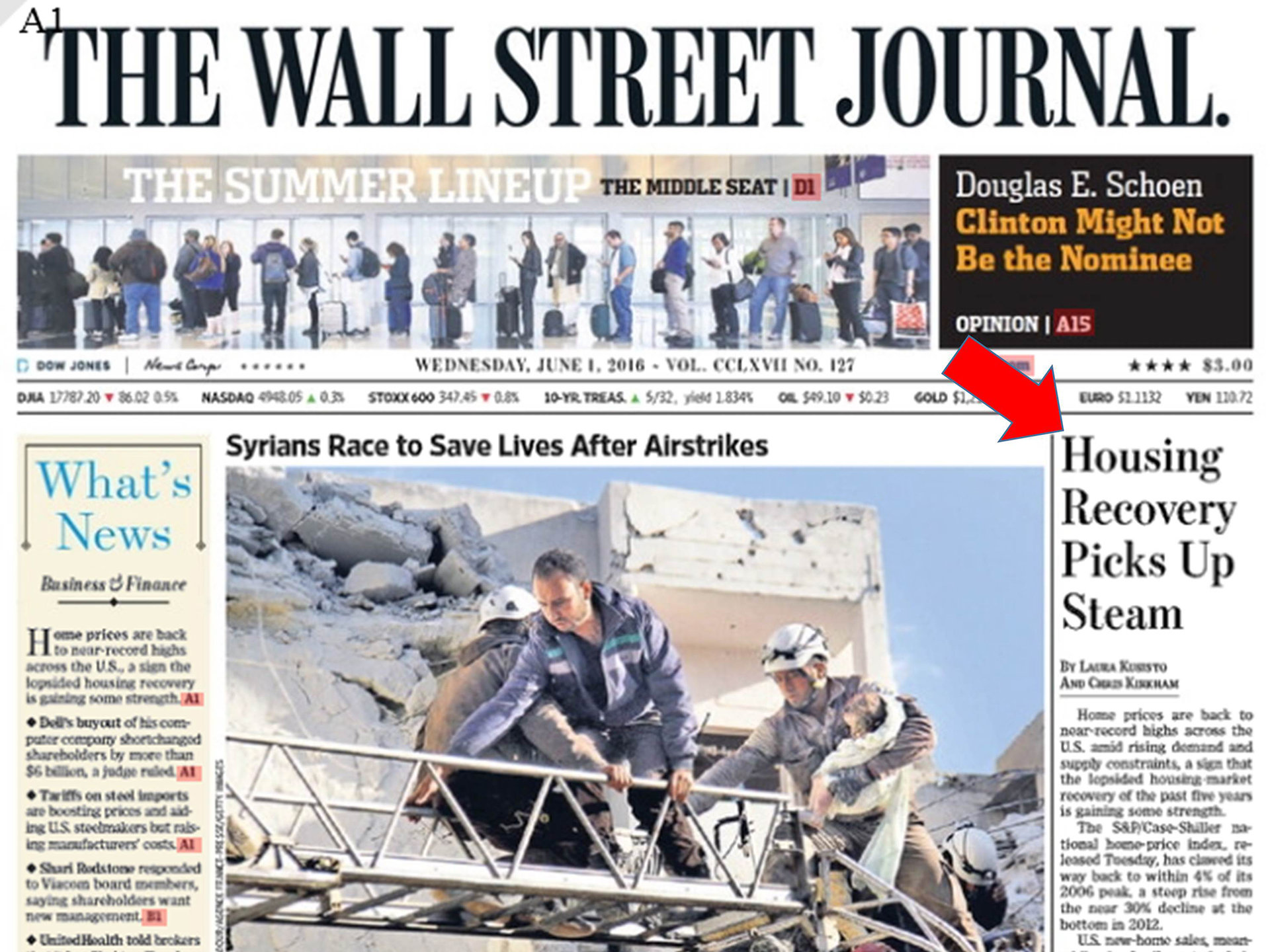
Yesterday, Keeping Current Matters ran a post quoting major housing experts on the increasing strength of the U.S. housing market. We were pleasantly surprised that, on the same day, the Wall Street Journal decided to run a front page story titled, “Housing Recovery Picks Up Steam”(article available to WSJ subscribers).
Wall Street Journal: Housing Recovery Picks Up Steam | Keeping Current Matters
The first paragraph of the article says it best:
“Home prices are back to near-record highs across the U.S. amid rising demand and supply constraints, a sign that the lopsided housing-market recovery of the past five years is gaining some strength.” (emphasis added).

What about the struggles in the economy? 

Some openly question how the real estate market can be gaining ground if the overall economy is still struggling. According to the WSJ, it is:
“Despite the unbalanced recovery, Federal Reserve officials have seen housing as a bright spot for the U.S. economy in recent years. Residential construction has contributed to overall economic output for eight straight quarters, expanding at a 17% annual rate in a first quarter marked by slow growth in other sectors.”

Bottom Line

The housing market is gaining strength and all indicators point to an even stronger real estate market moving forward.
(Original post from The KCM Crew)

Wednesday, June 1, 2016

Good News: San Francisco is in the Doghouse!

A new study says San Francisco is going to the dogs  — and we couldn’t be happier about it!
The City by the Bay is the most dog-friendly city in the United States, according to SmartAsset, a personal-finance website that compared data on dog accessibility and quality of life in 100 cities. Other California cities ranked in the top 10 include San Diego (No. 4) and Sacramento (No. 6).
San Francisco ranks seventh in the nation for the most dog parks per 100,000 residents (3.46) and has the second-highest walkability score (84 out of 100). But what really pushed San Francisco into the winner’s circle was the number of dog-friendly restaurant we have — 174. Only San Diego has more, with 187, but our neighbor to the south is also 50 percent bigger in terms of population. San Francisco also boasts three dog-friendly shopping centers.
Other factors that SmartAsset used in its calculations were weather (average days of rainfall) and housing cost (the median home sales price).
By the way, if you’re looking for those San Francisco restaurants that welcome dogs at their outdoor tables, point your web browser to BringFido. The website lists all 174 and lets you sort them by name, popularity, and ranking. It also provides maps, photos, and reviews.
The Curbed SF website also has some valuable dog-friendly links. For starters, check out its list of 25 pet-friendly rental buildings in San Francisco. It also offers a guide tracking the most pet-friendly ZIP codes for renters in the city.
Of course, your No. 1 link for the most doggedly dog-friendly people is that of the San Francisco SPCA. The nonprofit agency has been taking care of dogs and cats and all sorts of household pets since 1868. Last year alone it brokered 4,919 pet adoptions — 3,106 cats and 1,813 dogs. More than 11,000 pets were spayed or neutered, and 91,222 people were visited by therapy animals. The organization deserves our support.
(Read more on the Pacific Union blog)

Thursday, May 12, 2016

Positive Trends in Venture-Capital Activity to Impact Bay Area's Tech Employment

(By Selma Hepp, Pacific Union) A recent article in The Wall Street Journal on sales of ping-pong tables to tech companies hinted that slower sales are due to troubles in the Bay Area’s high-tech sector. Admittedly, it is an interesting approach to assessing the economy, but while everyone is looking for the slightest signs of what’s on the horizon, ping-pong tables are hardly a reliable indicator. There are many possible reasons for slowing ping-pong table sales, including that it is a durable item that is rarely replaced.
Nevertheless, there are more reliable indicators on which we should gauge VC activity and how it will impact the Bay Area’s tech employment and housing markets. For example, the quarterly Silicon Valley Venture Capital Confidence Index (Figure 1) measures and reports the sentiment of 30 professional venture capitalists on the funding environment in the Bay Area over the next six to 18 months. The index reached 3.59 on a 5-point scale (with 5 equaling high confidence and 1 equaling low confidence) in the first quarter of 2016, up from 3.39 in the previous quarter. The index increased at the end of 2015 following three quarters of declines, suggesting that optimism is rising among venture capitalists.
Figure 1:
StraightTalkMay16Chart1
Still, with no technology IPOs in Q1 2016 and a drop from 35 overall IPOs in Q4 2015 to 10 IPOs in Q1 2016, — along with lower valuations of some unicorns — a lot of conversations have been brewing about slowing VC activity. Numbers pertaining to deals and investments have been particularly alarming. After promising to be the best year since the dot-com collapse, the last quarter of 2015 was characterized by a notable drop in VC activity, which bled into the first quarter of 2016. The deal count for both quarters remained at the lowest level seen in over three years. Figure 2 highlights California’s VC-backed investment activity in the first quarter and where the top deals happened.
Figure 2:
StraightTalkMay16Chart2

At the same time, VC firms raised $13 billion during the first quarter of 2016, which is the largest total since the dot-com boom in 2000. Robust growth in fundraising is not surprising given the amount of liquidity in global markets. However, the question is why has the investment and deal activity slowed so much? According to the Venture Pulse Q1 2016 report by CB Insights and KPMG, the factors leading to the pause are similar to the jitters that slowed the stock market, including an economic slowdown in China, a drop in oil prices, an anticipated interest-rate increase, and an approaching U.S. presidential election. Also at work are general developments across the globe, not the least of which is the U.K.’s possible exist from the European Union.
Clearly, the VC funds raised will be dispersed over the coming quarters, but investors’ expectations and concerns have changed. Funders are looking for greater transparency — companies with solid balance sheets and business models that can demonstrate profitability, and more importantly, manage their expenses (like those aforementioned ping-pong tables). Unlike the times when investments were based on pure potential, venture capitalists are now scrutinizing start-ups to a greater degree, and funders will become more engaged in companies’ decision-making and spending processes.
Furthermore, the underperformance of some high-profile companies has brought existing and potential unicorns under scrutiny, and investors are recognizing that some valuations are too high. The company that best exemplified the trouble among IPO valuations was Square, which earned a $6 billion valuation in December 2014 but managed only a $4.2 billion valuation in its IPO on November 19, 2015. Today the company’s market cap is at $3.39 billion. And while experts argue that comparing these numbers is like comparing apples and oranges, Square’s high-profile IPO brought attention to the objective valuation of unicorns.
Since then, the recognition that high market valuations may not be warranted is leading to a greater focus on creating revenue and positive growth margins, controlling expenses, and setting a clearer path to profitability. Falling valuations are similarly leading investors to change investment instruments that give them protection and guarantees tied to potential IPOs. For example, Spotify raised funds using convertible debt, which came with strict investor guarantees tied to an anticipated IPO. Also, with unrealized valuations, there has been greater corporate participation and merger-and-acquisition activity instead of IPOs. This trend is likely to continue, as corporations look for new technologies and innovations that they can leverage within their own businesses.
Generally, investors are looking for new opportunities and focusing their attention on technologies that are at the beginning of the innovation cycle. Thus, unlike previous fascinations with consumer Internet companies (Uber and Airbnb, for example), much of the funds raised in the first quarter of 2016 went to the health-care industry. In fact, all 10 IPOS in Q1 2016 were in the health-care sector. Because of two large health-care deals in New York, the industry was the only one in the U.S. that actually saw an uptick in VC activity from the end of 2015. And if the Technology Hype Cycle (Figure 3) developed by research firm Gartner is any indicator of up-and-coming technologies, we may see more investment going into cybersecurity and artificial- intelligence firms.
Figure 3:
StraightTalkMay16Chart3
Source: Gartner
All things considered, while VC market strategies may be shifting, returns in 2015 for the 10-year period were almost twice as high as the Standard & Poor’s (S&P) returns. With the U.S. economy and the S&P market recovering from jitters and a continued strong job market, long-term VC activity still looks encouraging. And as fundraising activity for the beginning of 2016 suggests, there is no shortage of buying interest.
What Does This Mean for Jobs, and Particularly Technology Jobs in the Bay Area? 
San Francisco Bay Area job growth has outperformed California’s and the nation’s job growth since the recovery started. While the state’s unemployment rate reached 5.4 percent in March, the lowest level since 2007, most Bay Area regions have unemployment rates well below the state mark, generally ranging between 3 and 4 percent. The latest monthly employment gains came in lower than expected, but the numbers are expected to be revised up based on the number of total employed people.
Overall, the region gained about 118,000 jobs between March 2015 and March 2016. Unsurprisingly, the major employment centers, such as San Francisco and San Jose, accounted for most of those gains, but the composition of the job growth is encouraging.
StraightTalkMay16Chart4
Source: California Employment Development Department. San Francisco includes San Francisco and  San Mateo counties; Oakland includes Alameda and Contra Costa counties; San Jose includes San Benito and Santa Clara counties. Technology jobs are sum of Professional, Scientific & Technical Services and Information jobs.
In San Francisco, relatively large industries are growing jobs at the fastest clip — 13 to 16 percent over the last year — including jobs in computer-systems design and related services; construction, especially specialty trade contractors; and nondepository financial services (loan officers, for example). Fast growing, but relatively smaller in numbers, were jobs in higher education, performing arts, and food services.
About 8,300 jobs created between the first quarter of last year and the first quarter of this year were in computer-systems design and related services. While tracking technology jobs can be tricky, as they span across a number of industries, a solid annual gain of 13 percent in computer-systems design suggests that the technology sector in San Francisco is still healthy and strong. Also, it is natural that the pace of job growth moderates as the economy reaches full employment, and with the unemployment rate in San Francisco well below that, some softer numbers may not signal weakening of the local economy.
In Silicon Valley, job growth was relatively more broad-based, but among large industries, electronic computer manufacturing gained jobs at a faster rate than other industries. Again, similar to San Francisco, specialty trade contractors were in high demand and added a considerable number to overall new jobs. Faster job growth was also seen in administrative and support services and publishing, which includes software publishing.
In the greater Oakland region, trends follow the same patterns seen in other parts of the Bay Area. The fastest growth is again among specialty trade contractors, but trending close are jobs in computer-systems design and related services, publishing, and arts and entertainment.
The North Bay saw solid job growth in line with the region’s core competencies, including positions in tourism and food and beverage services. While there may be some growth in tech-related industries, it is still a relatively small number that may not point to any trends yet.
Clear growth in construction jobs across the entire region is welcome, as it points to greater housing construction. Generally, construction jobs have been growing at a relatively speedy pace over the last year. As a share of total employment, the construction sector contributes a much smaller share of jobs than it did during the mid-2000s housing boom.
Taken together, the trends outlined above suggest that technology employment is still robust and that job growth will continue. Another indicator that supports future tech employment growth is the number of job openings. According to an analysis of employment website Indeed.com, the San Jose metro area has the highest number of job openings per capita in the country. What is proving more difficult is finding the appropriate skill set and the right candidate for those open positions. Lastly, the anticipated increase in VC activity will help boost tech employment in general and possibly spur another round of ping-pong table sales.
Selma Hepp is Pacific Union’s Vice President of Business Intelligence. Her previous positions include Chief Economist at Trulia, senior economist for the California Association of Realtors and economist, and manager of public policy and homeownership at the National Association of Realtors. She holds a Master of Arts in Economics from the State University of New York (SUNY), Buffalo and a Ph.D. in Urban and Regional Planning and Design from the University of Maryland.

Thursday, May 5, 2016

An Inside Look at the Market

(By Alan Mark, The Mark Company) We at The Mark Company would like to take a moment to address a series of recent articles about the challenges currently facing the San Francisco residential real estate market. Despite what you may have heard, the San Francisco housing bubble has not burst. Let’s look at the big picture to understand the trends that are driving the current market and how they will continue to impact the market for 2016 and beyond.
Alan Mark, President of The Mark Company, offers some key points below on why not to panic and tips on how to succeed moving forward.

One: Oversupply is not an issue.

Despite over 62,500 residential units in the pipeline, San Francisco is far from being oversupplied today, tomorrow or within the next five to 10 years. There is a critical need for housing in San Francisco and chronic undersupply of new product. Of the over 35,000 approved residential units, over 28,000 are contained within large, master-planned communities with no timeline for delivery or guarantee that they will come to fruition. Given that the City is and always will be a highly-desirable place to live with limited land and lengthy entitlement processes, inventory is unlikely to ever truly meet demand.
In addition, for sale condominiums make up only 20 percent of the under construction pipeline. We’ve seen developers back off from delivering condominiums in favor of rentals, only to rush back to a condominium scenario when the market shows signs of improvement. Even with potential product in the pipeline, San Francisco will most likely not have 1,500 units on the market at any given time through this decade. A number of towers that are planned, but not fully entitled, will take three years to build when they do start construction. Furthermore, entitlements for future projects are in limbo as the required percentage of inclusionary affordable housing is being challenged.
Lastly, the Bay Area created approximately 120,000 jobs over the past year alone and has outperformed the country for the past four years. People are moving to San Francisco in droves and need housing. Sky-high rental prices make owning the better option.

Two: Low inventory will continue to drive pricing and demand.

The trend of very low inventory has bolstered demand and pricing. New condominium inventory remains historically low in San Francisco despite the addition of seven new developments during the past six months. To put it into perspective, there were fewer than 650 new construction condominium units available in San Francisco at the end of this quarter. Even with the recent addition of 298 units at The Harrison, we are facing a 70 percent decrease compared to the peak of over 3,000 units reached in 2007.
While approximately 860 new construction condominium units scheduled to enter the market later this year, buyer demand is expected to remain strong. This is evidenced by three developments recently launched by The Mark Company. Both located in Hayes Valley, 450 Hayes placed over 80 percent of its homes into contract within one month at an average price over $1.2 million, while 388 Fulton put 26 homes into contract during its first month. Featuring custom design by Ken Fulk, The Harrison launched in early April and welcomed over 170 onsite visitors its first week on the market, proof of pent-up demand for luxury product in one of the City’s most in demand neighborhoods of Rincon Hill.

Three: Fever pitch pricing to stabilize, but not diminish. 

 The market has recalibrated to a level that seems waning, but is actually close to where we were at this same time last year. The Mark Company’s San Francisco Condominium Pricing Index for March increased every month during the first quarter. Absorption remained steady and even slightly better than Q4 2015. These key facts help us point toward a normalizing market, not one on the verge of another recession.

 Four: Don’t panic. Do re-strategize.

 While we don’t believe another downturn is on the horizon, having strategies in place to address even the slightest of market corrections is critical to long-term success. A shifting market has unique pockets of opportunity for specific product types, buying groups, neighborhoods and price points. Identifying and capitalizing on these opportunities can have a huge impact on whether or not your project stays on track. Critical to our strategy is realistic pricing, a strong understanding of the competition and deep insight into what makes buyers tick.
Low inventory and high demand are the factors that have kept the market strong and will continue to keep it strong. The Mark Company believes that the outlook for the rest of the year remains positive, with solid real estate fundamentals driven by positive job growth and continuing demand by homebuyers to live in urban cores.
We invite you to also check out Alan Mark’s exclusive Q&A on the subject with GlobeSt.com.
We will continue to closely monitor the state of the market and how it affects our residential developments selling today and in the future. We encourage you to sign up to receive our Trend Sheet and Monthly Reports. Please get in touch should you wish to discuss further.

Monday, May 2, 2016

New Bay Area Restaurants: April 2016


(By Sarah Fritsche, SFGateAfter March’s mild lull, April saw an uptick in new restaurant openings. Read on for more details about the month’s most high-profile restaurants and bars, as well as this month’s other notable openings:
Mister Jiu’s: Probably the highest profile opening of the month was chef Brandon Jew’s long-awaited Chinatown restaurant. The remodeled main dining room and bar area are gorgeous and Jew is serving a multi-course Cantonese-meets-NorCal family-style banquet menu. If you visit, be sure to check out the fancy lazy-Susan tables that were designed by Jew and his cousin Ryan Lee.
28 Waverly Pl. (between Clay and Sacramento), S.F. misterjius.com
Wildhawk: Another prominent opening was the PlumpJack Group’s glamorous (and somewhat controversial) overhaul of the space that formerly housed beloved lesbian bar and community touchstone, the Lexington Club space.
3436 19th St., between Valencia and Mission, S.F. (415) 420-1516.wildhawksf.com
The only holdovers from the bar's Lexington days are the curved wooden bar and wooden floor. Photo: Liz Hafalia/The Chronicle
The only holdovers from the bar’s Lexington days are the curved wooden bar and wooden floor. Photo: Liz Hafalia/The Chronicle
Rancho Nicasio: April marked the debut of fine dining chef Ron Siegel in his new tenure at this historic Marin roadhouse. While known for his previous work at high-end restaurants like Michael Mina and the Dining Room at the Ritz-Carlton, Siegel says his contemporary American menu is more approachable.
1 Old Rancheria Rd., Nicasio. (415) 662-2219. ranchonicasio.com
Tony Gemignani’s Slice House: The 12-time World Pizza Champ has opened yet another outpost of his pie shop, this time inside Twitter Building marketplace, The Market. Look for his Walnut Creek outpost to open sometime in the next month or so.
1355 Market St. (in The Market), S.F. slicehouse.com 
Rooftop Restaurant & Bar: Speaking of Walnut Creek, this newly opened al fresco eatery will occupy the same venue that houses the U.S. outpost of Barcelona tapas restaurant, Teleferic, along with Gemignani’s forthcoming pizza shop.
1500 Mt Diablo Blvd., Ste 300, Walnut Creek. rooftopwc.com
Sweetgreen: Another new addition to the East Bay dining scene is this Washington, D.C.-based fast casual chain, which took over longtime Berkeley burger joint, Oscar’s. While the menu is a complete 180 from the previous occupant, happily much of the original architecture, including the sign, remain.
1890 Shattuck Ave., Berkeley. (510) 990-8262. sweetgreen.com
The Den: In addition to the usual pastries, Craftsman & Wolves’ new Bayview shop, which is adjacent to William Werner’s production kitchen and forthcoming confectionery kitchen, offers a pay it forward pizza program.
1598 Yosemite Ave., S.F. (415) 423-3337. craftsman-wolves.com
Den Scoop
The Den, located at Craftsman & Wolve’s Bayview production facility. Photo: William Werner
Bar San Pancho: Also in the Mission, Joe Hargrave and his Tacolicious team reopened the old Chino space with this latest incarnation, which showcases Mexican bar food.
3198 16th St.(at Guerrero St.), S.F. (415) 649-6077.
Basalt: Up in Wine Country, Moana Restaurant Group opened their latest in downtown Napa’s former Fish Story space.The menu from Esteban Escobar is seasonal Californian, peppered with the flavors of Spain, Mexico and Portugal. Former Chronicle Bar Star Jason “Buffalo” Lo Grasso is heading up the cocktail program.
790 Main St., Napa. (707) 927-5265. basaltnapa.com
Anchor Distilling Tasting Room: In addition to the historic Potrero Hill brewery tours, Anchor’s distillery has also started offering guided tours of its edible rooftop garden (home to the herbs and botanicals that are used in the spirits-making process) and production process.
1705 Mariposa St., S.F. (415) 863-5702. anchordistilling.com/tastingroom
WesBurger n’ More: The Mission Street brick-and-mortar of photographer/blogger/burger aficionado Wes Rowe’s beloved pop-up finally opened its doors. In addition to three different burger options, each made with Rowe’s signature coarsely ground, all-brisket patties, the menu also boasts Nashville hot chicken and three different kinds of tater tots.
2240 Mission St. (between 18th and 19th streets), S.F. (415) 555-1234. wesburgernmore.com
‘Aina: Another pop-up turned permanent, this one showcasing Hawaiian-inspired brunch opened in the Dogpatch neighborhood. The team behind the brunch spot are La Folie alums Jordan Keao and Jason Alonzo. If you go, be sure to order Keao’s malasadas with guava custard.
900 22nd St. (at Minnesota Street), S.F. (415) 814-3815. ainasf.com